
JBL ushers in new era for Eon and more
Published: PRODUCTS
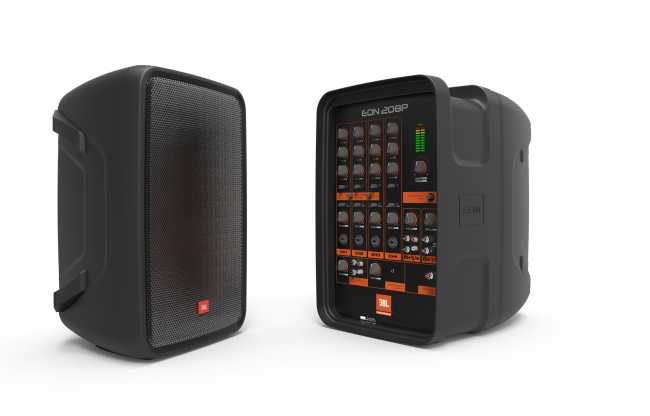
JBL has introduced Bluetooth streaming and an 8-inch format to its Eon range of portable enclosures with the Eon208P. Aimed at small bands, solo artists, coffeehouses, clubs, schools, meetings, worship events and health clubs, the Eon208P system comprises two 8-inch enclosures and an integrated 8-channel mixer.
Designed for both ground-stacking and pole-mounting, the cabinets house a single 8-inch woofer and 1-inch neodymium black nylon dome tweeter powered by a 320W amp section. On the mixer, channels one to four can accept either a ¼-inch instrument cable or an XLR cable and feature basic controls such as volume, reverb, treble and bass. Channels one to three also deliver phantom power. Channels five and six can accept either a stereo pair of ¼-inch TRS plugs or stereo RCA cables, and channels seven and eight accept a stereo 3.5mm input for mobile devices such as phones and tablets. Bluetooth devices can be used via the pair button.
Also new from the Harman Pro brand is the single 18-inch Sub18, which is aimed at the studio and postproduction markets, and is expected to particularly appeal to dance music producers. Described as ‘JBL’s most power studio subwoofer ever’, the sub includes JBL’s 2269 low frequency transducer and can produce a reported response of below 18Hz with 137dB peak output. Power is delivered to the passive sub by Crown iTech HD series amplifiers. According to the manufacturer, the birch plywood enclosure is 24-inches deep.
Moving back to the stage, the VTX M Series has become the brand’s new monitoring solution, again using neodymium Differential Drive woofers and the D2 Dual Diaphragm high frequency drivers plus a 60x60 high frequency waveguide. The range includes two models: the double 10-inch VTX M20, and the double 12-inch M22. Both include 3-inch D2430 compression drivers.
The enclosures can be switched between dual-channel (bi-amp) and single-channel (passive) modes. When switched to single-channel (Passive) mode, an internal passive network is engaged that allows users to drive M Series monitors with a single amplifier channel. However, the M Series splits the speaker preset responsibilities between the amplifier DSP and the internal passive network – the external DSP is responsible for frequency response correction, phase response linearization and component protection, while the internal network is only responsible for the component high-pass and low-pass filters. The combination of the internal and external processing recreates a typical Bi-Amplified speaker preset while only using one amplifier channel. The frequency, phase response and MAX output of the M Series is identical in both modes.
Finally, JBL has debuted two iOS apps for speaker angle and placement optimisation, named SpeakerAngle and SpeakerPro.
According to the brand, SpeakerAngle allows precise adjustment of toe-in angles, while SpeakerPro uses sound to measure the distance of each speaker to the listening position, as well as the distance between speakers. Distance is displayed accurately within fractions of an inch. Additionally, SpeakerPro uses distance data to provide intelligent toe-in angle recommendations Both apps can be used with Apple iPhone, iPad, or iPod touch devices. The angle of a speaker is measured by placing the iOS device on top of the speaker, touching an on-screen display, and then rotating the speaker toward the listening position until the optimum angle is set. SpeakerAngle works with any speaker make or model, in stereo or surround-sound.