
Deconstructing reconstruction
Published: WORSHIP
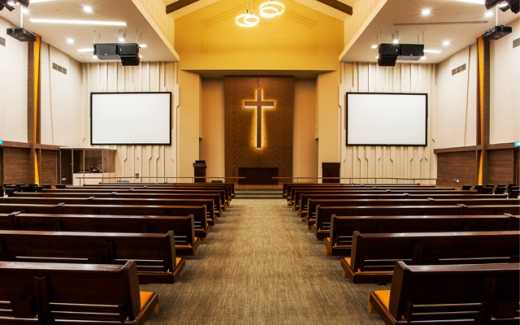
In a typical scenario, a church A/V technology consultant will be called to site in advance of any works being conducted. A number of discussions between the consultant, the church leaders, volunteers and others will ultimately channel the course towards a bespoke system being designed. Rarely will one be called upon to retrospectively assist upon a project in the midst of acoustic treatment and cabling. However, that’s exactly the situation in which Cogent Acoustics’ Robert Soo found himself when he was drafted by Yishun Christian Church.
The church, located in the northern Singaporean suburbs, is fairly unique in that it combines Lutheran and Anglican services under one roof. Two Sunday services are conducted by each denomination in Chinese and English back to back. The volunteer audio, video and lighting operators are kept on their toes as a result as the Anglican services are slightly more contemporary and charismatic in nature. Operating from a rear balcony control room however with analogue equipment proved to be something of a tall order and services suffered as a result.
When the 36-year old standalone sanctuary building was earmarked for extensive reconstruction, an interior designer provided advice and blueprints that would ultimately recreate the walls, the roof and the very fabric of the 12m high structure. During the reconstruction, the audio, lighting and video elements were brought to the fore. Following an evaluation of several audio demonstrations, Singaporean SI PAVE System Pte Ltd was successful in promoting its design based upon a Nexo point source system. However, the church committee realised that most of the reconstruction design had not taken any of the A/V installation into consideration. In addition, the reverberation time at the time was in excess of two seconds.
Enter Cogent Acoustics. ‘It was the first opportunity that I’d had to work alongside PAVE,’ admits Robert Soo. ‘Given I was called to the site late in the day, we managed to make some good amendments to the design, whilst proposing the required acoustic improvements. Back then, it was an empty, acoustically challenging 20m x 25m shell. Luckily we all came to an agreement and fully collaborated, arriving at a solution that would benefit the church as well as suit the intended interior design.’ A careful combination of polyester fibre panels and perforated wooden panels were strategically added to the multifaceted main walls, balcony and ceiling to achieve the right acoustical balance.
With the acoustic works completed in late November 2014, the race was on to complete the project before the busy Christmas schedule. Following three months of reconstruction, including the strengthening of the roof, the PAVE team was asked to complete its works within three weeks. ‘We practically lived on site prior to commissioning,’ admitted PAVE project manager Stephen Teo. ‘The stage is only a 500mm high raised floor, so with worshippers approaching the pulpit for kneeling and praying, we knew we couldn’t add subwoofers or front fills otherwise the spoken word would be unintelligible.’
The FOH loudspeaker system consists of L-R clusters suspended from the ceiling each combining two Nexo PS15 R2 15-inch cabinets with a single RS15 subwoofer. A further four Nexo PS8 speakers have been installed as under-balcony fills for the congregation in the rear sanctuary seats, whilst two PS10 R2 10-inch models offering 100-degree x 50-degree dispersion have been suspended from the ceiling as balcony delay speakers. The entire system is powered by a combination of three Yamaha four-channel NXAmp 4x4 and 4x1 digital TD amplifiers. Two active DXR10 Yamaha 10-inch speakers are used as stage monitors for the worship leaders. Finally, a rear 5m x 3m glazed cry room is furnished with two active Yamaha MSP5 speakers.
The six musicians on stage all use myMix personal mixers mounted on K&M stands, with outputs fed into an EX-16LA 16ch-ADT/analogue input module. With the removal of wedge monitors, the stage appearance is aesthetically clean and the worshippers in close proximity benefit from enhanced intelligibility. Six channels of Sennheiser ew-335 wireless receivers are available, whose signals are enhanced with the addition of two antenna boosters and ASA1 active splitters. In addition, the drummer, who is shielded by a screen, uses a comprehensive Sennheiser suite comprising three e-904s on the toms, three e-914s on the high hats and overheads, an e-9002 on the kick and e-905 on the snare.
The combined microphone inputs are fed into a 48-channel Yamaha M7CL-48V3 digital mixer via a DME24N digital mixing engine into which the sanctuary’s EQ settings have been saved. A Yamaha M16-AT card has been inserted into the console further providing 16 digital outputs. Mr Soo successfully convinced the church to relocate the FOH mix position for all three operators from a rear room on the balcony downstairs 10m in front of the musicians. ‘The volunteers requested the changes to be made,’ explains Mr Soo. ‘To be honest, I don’t know how they operated in the past as they couldn’t hear the audio or see the musicians from the location upstairs. One of them would leave the room and listen in order to adjust the EQ settings and levels. With the four services all being so close to one another and different in terms of style and musicality, saving the settings on the old analogue board wasn’t possible so the mixes were inconsistent. With the addition of the M7CL, they can save their presets and recall them in an instant.’
The three audio, video and lighting operators all have ample room in which to conduct their respective duties at FOH. With the addition of three Furman CN3600SE sequencers, the guesswork has been taken out of powering on and off. The previous video presentation was a lot more simplistic but the changeovers between inputting different feeds to the projection system was managed without a switcher. ‘The church realised that they required a smoother transition when switching from a PC to a camera, for example, as the worshippers expected this today,’ furthers Mr Soo.
With the addition of a Datavideo 12-ch HD/SD SE-2800 video mixer, the operator can instantly seamlessly change the inputs and screen content. Three Kramer FC-113 HDMI to 3G HD−SDI format converters, three DAC-70 cross converters and DAC-9P HD-SDI output embedded audio converters have been added to provide full signal conversions. Additionally, a Kramer VM-2HD HD-SDI amplifier receives the DVD input, re-clocks and equalises it before distributing the signal to two identical outputs. All eight inputs on the SE-2800 are currently used by a combination of HD cameras and PCs, which are output onto the two L-R Remaco 4.30m x 2.69m 16:10 diagonal fixed screens from two Panasonic 11,000 lumens PT-DW11K projectors. One of the inputs allows a camera in the adjacent building to stream live content from baptisms to the video matrix. The pulpit is also equipped with a 23-inch LED Samsung screen serving as a confidence monitor.
PAVE also installed an extensive lighting system onto two symmetrical ceiling suspended fly bars. Both fly bars combine eight ADB Warp 800W zoom profiles and eight ADB 1000W F101 fresnels, which are controlled on a PC loaded with Chamsys MagicQ software. Two 12-channel DX1220 Lite Puter dimmer modules completes the set up.
With the addition of so much new technology, the PAVE team spent as many weeks training all the various volunteers how to use the new technology as they had installing it. ‘We had to keep returning to the church to train them in groups, which is normal as they are not full time and cannot all come at once,’ explained Mr Teo. ‘When you consider that the musicians have switched from a fold-back to an in ear monitoring solution, the lighting operator is now working on a PC, the video operator is using a video mixer with more inputs and the audio technician is using a digital board, they are all on steep learning curves. Yamaha also assisted in training the audio technicians how to get the most out of the M7CL. However, having undergone all this training, they are really enjoying operating the services which sound so much better as a result of the acoustics and the digitally controlled, point source system. It’s a lot simpler now when switching services with stored presets and the worshippers are also delighted with the clarity and even dispersion. We are thankful to Yishun Christian Church in allowing us to implement these many changes, which they are now greatly benefitting from.’