
Happy Krishna
Published: WORSHIP
Founded in New York in 1966 by A C Bhaktivedanta Swami Prabhupada, ISKCON (International Society for Krishna Consciousness) is better known globally as the Hare Krishna movement. With around 550 centres worldwide, it was formed to spread the practice of bhakti yoga, or the dedication of the thoughts and actions of its devotees to serving Lord Krishna, one of the gods in the Hindu pantheon.
The basic purpose of ISKCON is to propagate spiritual knowledge to society at large and to educate people in the techniques of spiritual life in order to redress values and achieve unity and peace in the world. One of the movement’s seven purposes is to provide the community with centres of devotion and study, where people may be taught spirituality and experience a simpler way of life. Music plays a large role in ISKCON worship, such as the chanting of the Hare Krishna mantra and devotional songs known as bhajan and kirtan, which are performed during services with accompaniment by traditional Indian instruments and with the congregation joining in the call and response.
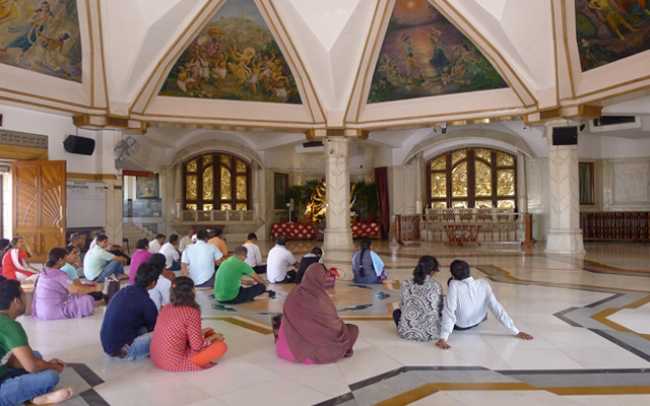
One of India’s foremost ISKCON temples is the Sri Sri Radha Parthasarathi Mandir, built in New Delhi in 1998 and inaugurated by then prime minister, Sri Atal Bihari Vajpayee. The heart of the temple is a marble worship hall where services, lectures, dancing and meetings take place, often to the accompaniment of live music. Experiencing problems with the hall’s ageing sound system, the organisation contacted T2 Consulting, whose associate consultant, Tanuj Chawla, takes up the story.
‘The temple was facing a challenge when it came to an audio solution,’ says Mr Chawla. ‘Their existing system was 15 years old and they’d been using it at peak volume, so only half the system was working. Quite often they would augment their installed system with a portable solution that they hired in and placed around the hall, together with a single microphone. As this is a multi purpose space, they needed one system that would work for everything. They decided that they wanted to upgrade the system and contacted us to act as a consultant.’
During T2’s first visit to the temple, it became clear the biggest challenge to be overcome was the acoustics of the hall. ‘It wasn’t possible to carry out any acoustic treatment because the hall is a sacred space, with thousands of devotees and visitors coming through every day,’ he explains.
The acoustic properties were particularly difficult given the hall’s marble construction and central glass dome supported by pillars, as well as lower ceilings around the room’s periphery. Additionally, further problems were caused in the environment due to the traditional drum used in Hare Krishna ceremonies, the Mridangam. This double-headed drum, with the bass on one side and treble on the other, is said to raise the consciousness of worshippers and enhance the effects of chanting the Hare Krishna mantra. It was reverberating badly around the marble hall.
Another issue for ISKCON Delhi was speech intelligibility – an important consideration when spreading spiritual teachings. ‘Numerous singers and speakers from the temple perform throughout the day, and if there was a mixer available to them then they would add some effects, change the volume and the effects, especially the reverb,’ says Mr Chawla. ‘As the space already has so much reverberation, this sounded terrible and the intelligibility was just gone. So we told them we could greatly improve things by automating the new system with a certain amount of presets and maximum volume control.’
T2 worked together with systems integrator Acoustics Arts, putting forward several different options for the temple. ‘We as a team gave them demonstrations of several systems,’ confirms Leo Thomas, sales and technical manager at Acoustic Arts.
One of the temple’s main considerations was that it wanted to install the highest possible quality equipment that it could afford on its budget. ‘The vice president of ISKCON Delhi, Raghav Pandit Das, was very involved with the selection process and wanted to install equipment that was made in Europe or the US, which they already had a reputation for using,’ says Mr Chawla. ‘That was one of the reasons we provided them with Lab.gruppen amplifiers, which are made in Sweden. It was an expensive option but the one they wanted. They also decided to go for a Tannoy speaker system out of several other options put forward.’
The ultimate decision to go with the Tannoy and Lab.gruppen solution was taken jointly by the ISKCON Delhi leaders, including Madhu Mangal Das. ‘We needed to do many things to improve our temple hall, because it has been designed in such a way that it creates echo and so many other problems,’ says Mr Das. ‘We needed sound intelligibility for our lecturers and speakers, and now we’ve installed the Tannoy sound system we’re getting so much more intelligibility. It sounds very good, and especially in the musical performances such as kirtan we’re getting very good audio quality.’
Acoustic Arts supplied four Tannoy VX 15HP 15-inch passive speakers as the main system for the hall, with two smaller VX 8s for the low-ceilinged area. These are driven by Lab.gruppen C28:4 and C5:4X amplifiers. Also supplied were a selection of new beyerdynamic microphones, including an OPUS 660 handheld wireless system, OM 302/304s and TG V35d s. ‘All the microphones have automated channel targeting and hyper-cardioid pickup patterns, so they would be producing much less distortion and more of the performance,’ says Mr Chawla.
T2’s design also included a Biamp Tesira Forte A1 DSP I/O server and a Biamp TEC-1 DSP controllable wall panel for source selection and volume control. The Biamp system has been programmed with presets for a certain number of singers and speakers. ‘All the presets have flat vocals and the system takes care of the reverberation, EQ and acoustics; it’s all done inside the Biamp,’ says Mr Chawla. The TEC-1 remote allows the system to be fully automated; users will be able to access the presets and a maximum volume control, and that’s it. They won’t be able to do anything else, which is what the temple wanted. A few certain people will be able to bypass this and edit configurations if needed.’
Once the temple had decided on the system, another major challenge presented itself. There were just four days for it to be installed in time for the temple’s most important annual event, the Janmastami festival, which takes place in August to celebrate Krishna’s birthday.
‘Luckily, TC Group and Acoustic Arts managed to get all the products we needed to carry out the installation in time for the festival,’ says Mr Chawla. ‘It was a big debut for the new system, as more than one million people came to the festival and enjoyed the music.’
Acoustic Arts was justifiably proud to have been involved with the project. ‘This is a prestigious installation for us,’ says Acoustic Arts’ Mr Thomas. ‘It’s not about the value of the project, this is a very famous temple and lots of people come here as devotees. So for us and for Tannoy, it was very important. We also like to work with T2 Consulting on their projects; it’s an honour to work with them because they are one of the top consultancy firms in India. So it was a great opportunity for us.’
Looking back on the installation, both Acoustic Arts and T2 Consulting are extremely happy with how it was executed, and grateful that they could be of service to the temple. As the system was to be chosen and operated by people who are not from an audio background, both companies worked closely with the end-users to ensure that they understood every stage of the procedure.
‘The biggest challenge was to educate the temple about the kind of solution we were installing,’ agrees Mr Chawla. ‘There are lots of people involved here who hold different positions, and who worship here. Many of them would be using it so they all had to be happy. Some of them have a practical knowledge of audio but when it came to the technicalities we had to showcase the solution for them and show them how it is operated and what the alternatives were. We brought in the Tannoy speakers, set them up in the positions in which we would install them and gave the temple a demonstration. They were happy with it straight away, and placed their order the following week.’
T2 also carried out some training on the TEC-1 automation system. ‘We’ve given training to several members of the temple so they will be able to operate the system,’ continues Mr Chawla. ‘We’ve set one preset which will be for vocals, to be used when there are lectures going on in the hall. They have lots of visits from school students, so this will be ideal for that. Then there are some presets for different vocalists and musicians who come here with their instruments, such as harmoniums and drums. The other presets are for recorded music, from a CD and MP3 player which we have connected. We can configure up to 32 presets which will be enough for them, and they will definitely be coming back and asking us for more presets once they start to figure out how it works. All the musicians seem pretty happy about the new system.’
And it’s not just the musicians who are enjoying the temple’s new sound system. ‘The congregation is happy because now they are able to hear lectures very clearly, without missing a word,’ says Mr Das. ‘In musical performances, each and every frequency is very clear and it’s pleasing to the ears and to the heart. It’s made a difference to the positive vibrations of the temple. When the sound was unclear, the listeners didn’t pay as much attention, but now the devotees and visitors can sit with us and enjoy it.’
Mr Das is also appreciative of the system’s ease of use. ‘It’s very simple to operate,’ he says. ‘It was installed for our main festival and it was a great start. We have many festivals here at ISKCON, there is one almost every week, but this was the biggest one we have here. As it celebrates the appearance day of Lord Krishna on the planet it is very important in our annual calendar. About a million devotees visited the temple on that one day and the sound was very good. We can have more than 700 people in the temple at a time, and they were coming through from 4am until midnight.’
An auspicious start, then, for ISKCON Delhi’s new sound system, and an installation that’s set to bring increased spiritual wellbeing to its devotees and visitors into the future.