
London Community Gospel Choir enters Guinness Book of Records with Soundcraft
Published: WORSHIP
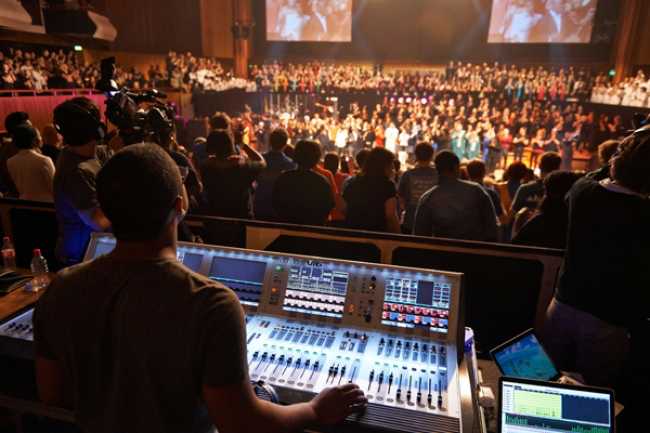
WORLD: Soundcraft helped The London Community Gospel Choir (LCGC) into the Guinness Book of Records last weekend when sound engineers Raphael Williams and monitor engineer Nikoma Bell specified 96- and 64-channel Soundcraft Vi6 consoles respectively to mix the largest gospel choir ever assembled on a stage.
The event was held to celebrate LCGC’s 30th anniversary, which culminated in a three-day series of performance and workshops at London’s South Bank. The highlight was the concert at the Royal Festival Hall, and since this was being multi-tracked for a live album and DVD, recording engineer Simon Changer also had a third, remote 96-channel Vi6, isolated in the back control room.
In order to beat the previous record of 1,138 voices singing together in concert conditions, LCGC invited 30 other gospel choirs from across Europe to participate, so that the front tier stalls of the hall also became a performance area for the extended choir. The show included UK X Factor runner-up Jahmene Douglas and Magic FM DJ Angie Greaves, and the existing record was broken due to an ensemble of 1,169 vocalists performing simultaneously.
‘It was Nikoma who first introduced me to the Vi6,’ said Mr Williams, who also acted as overall technical adviser on the project. ‘Since then I’ve become a Soundcraft man through and through.’
Mr Williams has a strong background in church music, having started out in a minor role in 2010 before choir principle, Rev Bazil Meade, approached him to take the lead role for this particular project. All sound equipment was provided by Richard Nowell Sound Systems (RNSS).
While the choir itself, directed by Becky Thomas, featured 50 singers, the prospect of miking up nearly 1,200 vocalists created a number of logistical pressures as he set about providing a large inventory of industry standard close and ambient/overhead mics from the RNSS inventory.
‘I put together a complete list of what could happen in a perfect world,’ Mr Williams explained. ‘We started at 150 channels consisting of band, acoustic section and vocals, with 40 direct mics, and a further 48 dotted around the hall. But closer to the time I reined it in and made it more realistic in keeping with the 96 channel desk count, with nine direct mics for the main members of the choir and 12 large diaphragm mics for the remainder. These are dotted around the stage for the choir to look more artistic.’
Mr Williams filled his Vi6 to capacity with 30 band and 21 LCGC mics, plus four radio and 24 mics for the extended choir, eight ambient mics within the room and some playback tracks from the hard disc recorder.
‘What I like about the Vi series is ultimately the sound, which is clear, crisp and clean,’ he stated. ‘The gain structure allows you enough headroom, and I also like the usability – it’s very easy to move around on and because of the Vistonics. Each screen is independent and so you can do two things at once – it makes things flexible.’
The channel count required had to be able to handle the recording workflow of 96 channels to a Madi device. ‘To get all 96 ins and 96 outs I had to swap some of the cards to get more Madi outs,’ he said.
His solution was to design a four-card Madi card configuration based on 64-ch in, 32-ch out (card one); 32-ch in, 0-ch out (card two), 64-ch in, 64-ch out (card three) and 24-ch in, 32-ch out (card four).
‘The Vi6 is always my desk of choice,’ added Mr Bell. ‘There are other great desks out there but I can configure and use the Vi with my eyes closed, often getting 80 per cent of the mix sorted via the offline software before even switching the desk on. It sounds amazing too!
‘The ability to configure the show offline really helped on this occasion due to the channel count,’ he added. ‘I was using every input and output, seeing 64 lines from stage then 12 return lines from FOH, as well as my effect returns and local inputs. But as I could configure the console on the train to rehearsals it saved a lot of time, allowing the band to get on with what they needed to do.’
‘The Soundcraft Vi6 was the central hub that enabled us to break the world record for the largest choir ever,’ enthused musical director/production manager, Ayo Oyerinde. ‘From FOH, monitors to multi-track recording, the Vi6 took care of it all with the highest quality sound.’