
Taking a new line
Published: WORSHIP
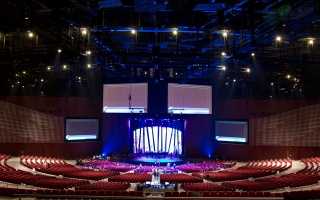
Guatemala City’s new landmark Casa de Dios church needed an audio system for 12,000 people, but a line array was not the right answer...
Nestling on the top of a mountain, overlooking the heavily populated landscape that is Guatemala City, the recently opened Casa de Dios church is one of Central America’s latest architectural wonders, a new iconic landmark acting as a beacon of hope for a country that is steadily rebuilding itself on the world’s stage.
This impressive structure is the latest achievement for pastor Cash Luna and his followers. Years of careful planning and fundraising have finally given them a new home, one that has space for a congregation of over 12,000 in the main hall, as well as satellite youth churches on either side of the main building.
As with any modern house of worship, the audiovisual element was carefully planned from the start, with Michael Garrison Associates, pastor Luna’s chosen partner for the A/V and lighting installation, working with the architect from the initial stages, adapting the overall design to accommodate a system that would cope with all that was required.
‘Our first involvement for the first six or seven months was working on the design of the interior of the room and getting that right, and of course supporting the audio video systems and making it good for acoustics,’ explains Michael Garrison, head of MGA, whose team have worked on the project for almost seven years.
‘Because of its depth, the room was very appropriate for a line array, so the initial design included a top shelf line array system and we designed the rest of the sound, video and lighting systems around that. Then well into the project, I think around October 2010, we learned that they planned to zone the seating and accommodate meetings that were for way less than the 12,000 people, and they wanted to be able to shut the lighting as well as the sound down in those unoccupied areas. We informed them at that time that you can’t do that with a line array system. So they sent us on a quest to come up with a different solution.’
A long time user of Tannoy products in many installations in the US, Mr Garrison turned to the UK-based manufacturer for a possible answer. Included on the list was its flagship VQ Series, incorporating DSP, network control and dual channel Class-D amplification.
‘Initially, we looked at that and a couple of other brands,’ says Mr Garrison. ‘When we modelled all of it, we were very surprised to find that, in the computer modelling, the Tannoy VQ system – an exploded cluster for the main and two delay rings of satellite delay speakers – actually exceeded the max sound level of the very fine line array system, and with much smoother coverage.’
With pastor Cash Luna having the final say on the project, MGA took its modelling data to him and it wasn’t just the SPL levels he was impressed with.
‘When we showed the coverage to the pastor and the cost comparison, his mind was made up,’ Mr Garrison recalls. ‘Using VQ instead of a line array saved this project something in the region of US$500,000. When he heard that, the pastor said: ‘I don’t care about the touring riders. If they want to play here, they will play with my system.’ He was also the proud, long-time owner of a Tannoy home cinema system, so he was very excited to have Tannoy in his ‘big room’. We don’t normally hear that kind of enthusiasm. Down here in Latin America, they really didn’t know much about Tannoy. They will now.’
With assistance from Graham Hendry, VP of TC Group’s Applications Engineering and Support division, the team at MGA have designed and installed a system that is unique to the space, but one that also considers aspects such as line of sight and aesthetics as well as the general acoustics.
Graham Hendry says: ‘Normally when one is presented with a venue of this size and magnitude, your first thought would be which line array to use. It’s a serious sized venue, and you can’t see a speaker anywhere, unless you really look. Casa de Dios has a very well deployed point source system using VQ boxes. While it’s a house of worship, in essence, this is a performance install system, but it will achieve everything that a touring system does, and then some. It may take a little bit longer to install, but the end results in terms of performance and acoustics speak for themselves.’
When considering the relationship that MGA has shared with Tannoy during the Casa de Dios installation, Steve Shewlakow, MGA’s senior A/V designer for the project, says: ‘The support from Tannoy has been incredible. Each step of the way, Graham Hendry from AET came out to help us. I can remember several conversations with consultants across the country that Graham brought together to discuss some of the potential issues that we would have with the LF array. It’s been an incredible experience.’
Regarding the system itself, Mr Shewlakow continues: ‘We’ve used the VQ system a number of times and had really good success with it, and it’s a pleasant system to work with, lots of horse power behind it and a really high fidelity sound. There is effectively one main exploded array flown above the stage consisting of five sources. Having such defined pattern control, the VQ60 makes the horizontal coverage seamless; as a point source the vertical dispersion is perfectly consistent and not hampered by vertical inconsistencies inherent with line array; especially at high frequencies. There are two further delay rows consisting of VQ60s which will allow zoning to accommodate smaller congregations. There’s also a main LF array that consists of 18 VNET 218DRs and nine of the VNET 215HLs, and then a supplemental five-position delay zone with three VNET218DRs in each zone in a cardioid array. There’s also two subs on the ground that act as warmers and front fills.’
One of the most interesting and unique aspects of the installation is the central subwoofer cluster that sits directly in the middle of two large video screens, described by one onlooker as ‘hiding in plain sight’.
‘We’ve learned along the way that in Latin America, they have an aesthetic taste for audio quality that is different than in North America,’ smiles Mr Garrison. ‘They like a lot of bass, so we knew from the beginning that we couldn’t use the usual US reference points for that, and we would have to put in a low frequency and sub-woofer system that would go beyond what would be expected in the US.
‘With the help of Tannoy, Graham Hendry and other people, we came up with a three wide array that is nine boxes tall, so a total of 27 boxes – 218s on the outside and 215 boxes in the centre – for the main LF subwoofer array. Then we have some supplemental units at floor level because people want to be able to feel additional sub to reach the outside edge, but because the room is so deep and because they wanted to be able to zone it, we also have an additional delay ring with five positions, with three double 18s each. It comes to around 42 subwoofer devices in the room, and it’s pretty amazing. Working with signal timing, we were able to achieve wide dispersion, and it’s a wide fan room.
‘When initially installed, before some of the timing, there was a typical ‘power alley’ down the middle of the room, but we knew we would be able to spread that out. Working with Tannoy, and with the modelling and prediction, we were able to achieve wider coverage.’
Of course, with any installation of this size, the project threw up some surprises along the way, and the capability of VQ on this scale was the biggest one for Mr Shewlakow. ‘Coming to the realisation that these small VQ boxes could deal with a room this large, that was a shocker to all of us,’ he comments. ‘The first time we turned them on, it was quite an experience, and it took the doubts away about not using a line array. The pastor’s reaction, even in what was just a pure concrete shell, was shocking and stunning. The system, in that raw form, was performing way beyond our expectations – you could tell there was a lot of potential and we were looking forward to trying it when the room was finished.’
Mr Garrison is equally enthusiastic. ‘We could tell very early on that the computer modelling and the real life performance was matched very closely,’ he explains. ‘This is one of the smoothest systems from the perspective of evenness of coverage; side to side, front to back, it falls well within a plus or minus 2db variation. We’re very happy with it, the pastor is happy with it, and the sound people are very happy with it.’
For Eddy Cano, MGA’s director of Latin America operations and a Guatemalan native, the inauguration ceremony was an emotional affair.
‘I am very proud to be part of this,’ he says. ‘There are no words to describe what this is going to do for our economy, for our tourism. This is going to change lives, and change families. There’s going to be a lot of good heard, and seen, in this place. One of the things that pastor Cash talks about all the time is that people come to church to hear and to see, and churches around the world should strive to make sure its congregation should hear and see well. This is the message being taught in this place, and it has to be a clear message. Tannoy is helping to deliver that.’